

I’m sending out February’s bonus recipes earlier than usual this month while I take a bit more time to finish up the next edition of Weeknight Simple. Sometimes the rhythm of creating needs a little extra space, and rather than rush it, I wanted to share these with you first.
Valentine’s week felt especially fitting for these recipes. This space usually leans toward food that feels nourishing in very tangible ways, and even my desserts often carry some intention around protein, fiber, or gentler sweeteners. But sometimes, the most nourishing thing you can do is allow yourself a simple sweet treat. No optimizing. No upgrades. Just pleasure.
Where better to turn to than Baking and the Meaning of Life: How to Find Joy in 100 Recipes by Helen Goh. Many of you will know Helen from her work with Yotam Ottolenghi, where she spent more than a decade as a pastry chef and recipe developer and co-authored Sweet and Comfort. Interestingly, Helen also has an active psychotherapy practice, and that perspective runs profoundly through the pages. This book is not just about baking, but about why we bake at all — how food creates connection, marks milestones, and brings small moments of joy into everyday life.

While the book is ripe with inventive flavor combinations that showcase Goh’s creativity and multicultural heritage, I chose two recipes that reflect my own tastes in dessert, which, if I’m being honest, are very similar to my six-year-old’s. Vanilla. Chocolate. Nothing fancy. The Chocolate Cake for Everyone is dairy-free and allergen-friendly, the kind of cake you can confidently share at school or serve to a crowd. And the Perfect Vanilla Cupcakes are exactly that, soft, familiar, and deeply comforting.
Whether you bake these for yourself or for someone you love, consider this a gentle Valentine’s invitation. Eat mindfully. Slow down. Savor every bite. Sometimes sweetness, on its own, is enough.
Chocolate Cake for Everyone
Makes one 9-inch (23 cm) cake for 10 to 12 people
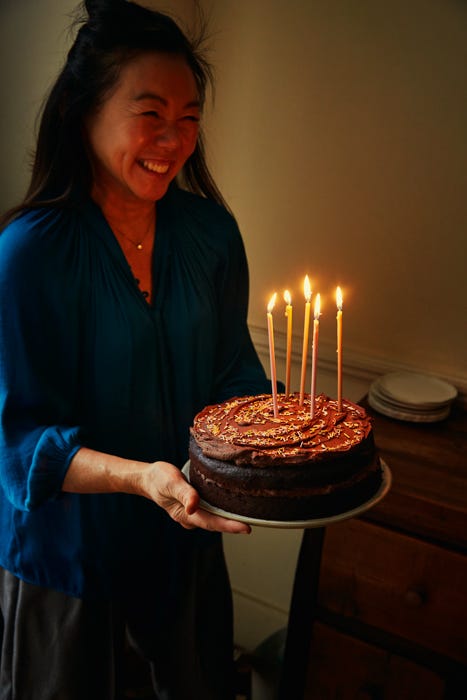
One of my son Sam’s favorite teachers, Mr. O’Hara, is very good at devising fun extracurricular experiences for the class. One of his ideas is to have a Bake Off Friday, where three children bring in their homemade cakes and cookies. The children take it quite seriously, and when it was his turn, Sam wanted to make a chocolate cake that the whole class could eat (three of his classmates have allergies, and they usually get a bag of Haribos!). Together, we came up with a chocolate cake that is free of nuts, dairy, and eggs.
I love this cake. It has an old-school, comforting taste and the texture is addictively fudgy.
The quality of the cocoa powder is paramount here. My preference is for Dutch-process cocoa, which has been treated to mellow its natural acidity. It’s typically darker and richer in flavor than natural cocoa, with a smoother, less bitter taste. Brands such as Droste, Guittard, and Valrhona are good, and are generally available online and in some large supermarkets.
Cake
2/3 cup (80 g) soft dried apricots
½ cup (120 ml) water
1 cup (240 ml) oat (or other plant-based) milk
1 tablespoon apple cider vinegar
½ cup (120 ml) melted coconut oil or sunflower oil
1 tablespoon vanilla extract
1 ½ cups (300 g) granulated sugar
2 cups plus 6 tablespoons (300 g) all-purpose flour
1 cup (80 g) unsweetened cocoa powder (preferably Dutch-process)
2 teaspoons baking powder
1 ½ teaspoons baking soda
1 teaspoon fine sea salt
1 cup (240 ml) hot water from a recently boiled kettle
1 teaspoon instant coffee powder (optional)
Frosting
½ cup plus 2 tablespoons (150 g) plant-based butter
2/3 cup (60 g) unsweetened cocoa powder (preferably Dutch-process)
2 ½ cups (300 g) powdered sugar, sifted
1 ½ teaspoons vanilla extract
2 tablespoons plant-based cream
To finish
rainbow sprinkles, for decorating
Preparation and Serving Tips
> The batter is quite runny, so it’s best to use a cake pan that is watertight. If your tin has a removable bottom, line it carefully with parchment paper, and place the pan on a baking sheet before it goes into the oven.
> If you want to make the cake gluten-free, substitute gluten-free flour for the all-purpose flour. The only drawback is that it will be difficult to slice the cake into 2 layers, because the lack of gluten means the cake has less structure. Instead, divide the batter into 2 pans to bake the layers separately (decrease the baking time to about 20 minutes), and sandwich them together with the frosting once baked. Alternatively, make the cake in 1 pan and skip the layer of buttercream in the middle. Top generously with the frosting to make up for it!
> For decoration, I adore rainbow sprinkles and long candles for a birthday celebration, but for a more classical look, you can pipe rosettes or swirls on top and around the cake (just make a little extra frosting for this purpose). Assorted fresh edible flowers also look beautiful.
1. Grease the bottom and sides of a 9-inch (23 cm) round cake pan with parchment paper, then preheat the oven to 375˚F (190˚C).
2. To make the cake, combine the dried apricots and water in a blender and blitz to a fine puree. Scrape the puree into a large bowl and add the milk, vinegar, melted coconut (or sunflower) oil, and vanilla. Add the sugar and whisk together to combine.
3. Sift the flour, cocoa powder, baking powder, baking soda, and salt into a separate bowl, then add to the wet mix. Stir gently with a whisk—it won’t quite combine yet—then add the hot water and coffee (if using). Whisk gently until fully combined, then pour the batter into the prepared cake pan. Bake for about 1 hour, or until a skewer inserted into the middle of the cake comes out clean. Remove the cake from the oven and onto a wire rack to cool completely in the pan.
4. Meanwhile, make the frosting. Combine all the ingredients except the cream in the bowl of a stand mixer fitted with the paddle attachment and beat on low speed for about 2 minutes, until it comes together, scraping down the bowl halfway through. Add the cream and beat on medium-high speed for about 2 minutes, until the frosting is smooth and creamy.
5. When the cake is completely cool, remove it from the pan and slice it in half horizontally with a long knife. Place the bottom layer of the cake onto a serving plate, cut side up, and top with about half the frosting. With a small spatula, spread the frosting evenly over the cake, right to the edges, then gently place the other half of the cake, cut side down, on top. Spread the remaining frosting in an even layer over the top. Decorate with sprinkles, or as you like.
Perfect Vanilla Cupcakes
Makes 12
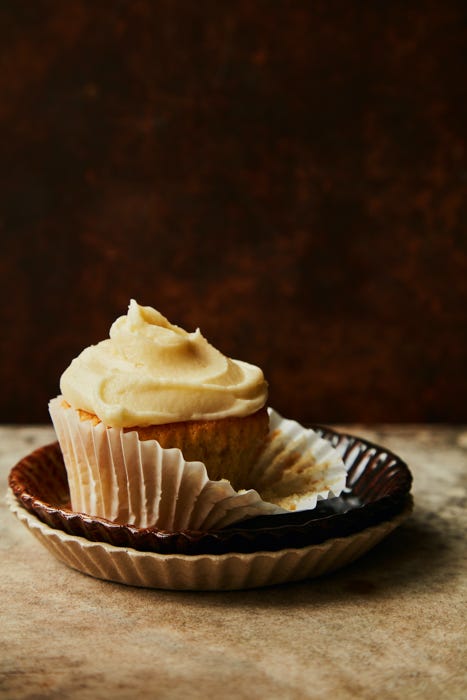
I love the almost limitless breadth and variety of baking. I love extravagant showstoppers, intricately engineered bites, and creamy confections. But I also love simplicity—the deep satisfaction of a perfect, simple cake. And what better simple cake than a cupcake?
A PVC (perfect vanilla cupcake) is like an LBD (little black dress) in your wardrobe—everyone needs one. Dress it up, dress it down; it’s good for almost any occasion. Just like an LBD, a PVC is both essential and hard to find. Once I had landed on what I thought was the perfect recipe, only the name concerned me. Perfect? Surely disappointment was guaranteed. But my friends, who initially shared my skepticism regarding the wisdom of calling any cake “perfect,” withdrew their objections on tasting it, so I am boldly sticking to my claim!
Close-textured, light and fluffy, with a homey, vanilla flavor, this is perfectly simple and deeply satisfying.
Cupcakes
1 ½ cups (190 g) all-purpose flour
½ teaspoon baking powder
¼ rounded teaspoon baking soda
¼ rounded teaspoon fine sea salt
2 large eggs
1 cup (200 g) granulated sugar
2/3 cup (140 g) unsalted butter, very soft
2 teaspoons sunflower or other neutral oil
seeds from ½ vanilla bean
1 teaspoon vanilla extract
½ cup plus 1 tablespoon (130 ml) plain unsweetened kefir or buttermilk
Vanilla frosting
½ cup plus 2 tablespoons (130 g) unsalted butter, soft but not oily
4 cups (500 g) powdered sugar, sifted
2 teaspoons vanilla extract
⅛ teaspoon fine sea salt
¼ cup (60 ml) whole milk, at room temperature
Preparation and Serving Tips
> The key to success with this beautiful crumb is the consistency of the butter— it must be soft without any part of it melting. Leave the butter at room temperature on the countertop overnight for best results.
> Small fresh fruit like berries are delightful as a decoration, especially if making the cakes for an afternoon tea or as part of a dessert table for an event. Alternatively, scatter with sprinkles if making the cupcakes for a birthday party.
1. Preheat the oven to 350˚F (175˚C) and line a 12-hole muffin pan with cupcake liners.
2. To make the cupcakes, first sift the flour, baking powder, baking soda, and salt into a medium bowl, and set aside for now.
3. Place the eggs and sugar in a food processor and process for 30 seconds to combine. Add the softened butter and process for about a minute, until the mixture is smooth and creamy and the butter is fully incorporated. Add the oil and vanilla (both seeds and extract) and pulse for a few seconds to combine. Now add about half of the sifted dry ingredients and half the kefir (or buttermilk). Pulse 10 times, then add the remaining flour and kefir and pulse another 10 times. Scrape the bowl down with a flexible spatula and pulse another 10 times, until the batter is smooth and creamy.
4. Spoon the batter into the 12 muffin holes, filling them about two-thirds up the sides—about 2 ¼ ounces (60 g) per cupcake. A large latch- release ice cream scoop is very useful here if you have one.
5. Bake the cakes for about 20 minutes, or until a skewer inserted into the middle of the cakes comes out clean. Transfer the muffin pan to a wire rack to cool for a few minutes. When cool enough to handle, remove the cupcakes and place on the rack to cool completely. Meanwhile, make the frosting.
6. For the vanilla frosting, place the butter and half the powdered sugar in the bowl of a stand mixer fitted with the paddle attachment and beat on medium-low speed for about 1 minute, until the mixture comes together. Add the vanilla and salt, then increase the speed to medium and beat for a couple of minutes, until light and creamy. Decrease the speed to low and gradually add the milk, then add the rest of the powdered sugar, 1 heaping spoonful at a time, mixing well after each addition. When all the powdered sugar has been added, increase the speed to medium- high and beat for another couple of minutes until light and fluffy. Cover and store at room temperature for up to 1 day until ready to use.
7. Spread the tops of the cooled cupcakes with the frosting, swirling decoratively as you please. Leave the cupcakes plain or scatter cake sprinkles on top.
Excerpt from Baking & the Meaning of Life (Abrams) by Helen Goh
© Helen Goh 2025
Photography © Laura Edwards 2025
Happy Valentine’s Day! I’ll see you next week with the February edition of Weeknight Simple, xoxo